Friday, June 12, 2020

TARTAR SAUCE WITH THAT FISH?


While watching THE TARTARS (1961), any thinking person would have to wonder just how badly did Orson Welles and Victor Mature need the money they were paid to appear in this turkey? It can't have been a large sum of cash (although I suspect Welles probably demanded and got more money than Mature), but still, given the ultra low budget of this picture, it couldn't have been much. Besides, a sizeable portion of said budget probably had to go to booze and food for Welles and extra oily hair gel for Mature.

The exteriors of THE TARTARS were shot in Yugoslavia, with interiors lensed in Rome. The picture plays fast and loose with ancient history in this muddled yarn of Vikings vs. Tartars. Welles is convincing enough as warlord Burundai but Mature is hopelessly miscast as a Viking chieftain. His dark looks and mini-skirted garb stand in marked contrast to the rest of his men who are all clearly Italian extras clad in helmets with immense horns and similar looking long blonde wigs. 

Still, there's material in the screenplay (written by a committee of Italian scenarists) for a fairly decent little sword and sandal adventure. There are plenty of battle sequences with swords, axes, bows and arrows, catapults, battering rams, etc., but all of these scenes are remarkably restrained and produce not a drop of onscreen blood.

And if you look carefully at the big duel scene between Welles and Mature that climaxes the film, you'll note that neither of the men ever appear in the same scene together. Mature is shown in close-up, the film cuts to a close-up of Welles, then a medium shot of what are clearly stand-ins. It's doubtful that the men ever had any real time together off screen during the production of the film. Indeed, the majority of Welles's scenes are all shot on a sound stage, a perk that might have been demanded in his contract. 

I really shouldn't obsess about mistakes in a film such as this but I can't help but call attention to how the Viking "fort" is constructed. Most forts throughout history have consisted of four walls to repel attackers and keep people safe inside. Not this one. 

The Viking fort is constructed of only three sides of wooden posts. Where the fourth wall should be, is a river bank. That's right, the rear of the fort is totally open to attack by any ships that chose to sail down river. In fact, three Tartars attack the fort in just such a manner, swimming across the span to launch a guerilla style raid from the rear. Why didn't the rest of the Tartars employ this strategy, rather than waste men, horses and weapons in a frontal assault?

I know, I know, it's not worth the effort to think about but it made me curious. 

Oh, and if you're wondering where the title for this post comes from, it's from eating many a meal at the legendary Luby's cafeterias, a Texas based chain of eateries that are now almost all gone. Good times at Luby's.

And yes, I did want tartar sauce with my fish. 


Thursday, June 11, 2020

WOMAN ON THE RUN

Woman on the Run (Universal International, 1950). Half Sheet (22 ...

It would not have been false advertising to pitch the finale of WOMAN ON THE RUN (1950) as a roller coaster ride of thrills and suspense. That's because the climax of this little jewel of a film noir takes place at a creepy amusement park at night (and why is it that amusement parks are almost always creepier at night? ) with heroine Eleanor Johnson (Ann Sheridan, in her first film after buying out her contract at Warner Brothers), rides a rickety roller coaster while a killer menaces her husband on the pier below.

It's a crackerjack sequence aided tremendously by off kilter camera angles courtesy of cinematographer Hal Mohr and a crazy,  hurdy-gurdy score by Arthur Lange and Emil Newman. The action leading up the exciting finale isn't bad either, in fact, it's top notch. Everyman Frank Johnson (Ross Elliott) happens to witness a gangland shooting while out walking his dog one night. The killer fire a couple of shots at Frank before leaving the scene. The police, let by the doggedly determined Inspector Ferris (Robert Keith) are determined to have Frank testify but he disappears before then can take him in.

The cops turn to his estranged wife, Eleanor, who is one hard bitten, cynical and tough dame. She's quick with a one liner but there's little humor behind her delivery. She doesn't care about Frank and wants nothing to do with the case. But newspaper reporters Daniel Legget (Dennis O'Keefe), wins her over and offers a substantial cash payout if she'll help him find Frank and get an exclusive story for his tabloid rag. 

The two begin a manhunt through the streets of San Francisco, trailed by the police every step of the way. In the course of the search, Eleanor discovers that Frank still loves her and she him and she becomes determined to find him and make an attempt at reconciliation. The identity of the killer is revealed to the audience midway thorough the film but rather than detract from the narrative it only serves to heighten the suspense. 

Produced by Fidelity Pictures Corporation and released through Universal International, WOMAN ON THE RUN is better than it has to be in what could be viewed as a rather routine thriller. Director Norman Foster does a good jo with the material laid down in the script that he co-wrote with Alan Campbell. The cast is first rate and the on-location cinematography adds much to the proceedings. 

The standout in the cast is, of course, Sheridan. While under contract at Warner Brothers the studio promoted her as "The Oomph Girl", a decidedly sexist label that served to typecast the young beauty and limit to certain types of roles. In WOMAN ON THE RUN, she has a chance to show her dramatic abilities to good advantage. 

But there's no denying that she certainly was a very attractive woman.


Happy 104th Birthday Ann Sheridan – Waldina


Monday, February 17, 2020

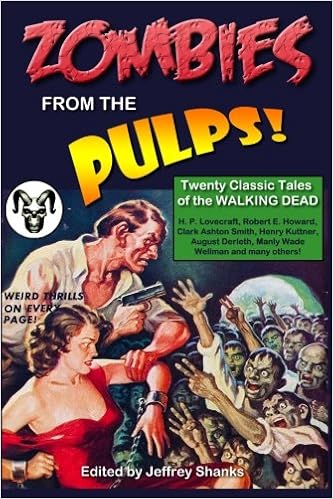
ZOMBIES FROM THE PULPS!

Image result for zombies from the pulps!

Just finished reading ZOMBIES FROM THE PULPS!, a handsome trade paperback published by Skelos Press in 2014 and edited by Jeffrey Shanks. The book collects twenty short stories about zombies that were originally published in various pulp magazines between 1922 and 1941. Magazines represented here include the immortal WEIRD TALES as well as  UNKNOWN along with titles such as DIME MYSTERY, TERROR TALES and SPICY MYSTERY, mags that trafficked in more lurid, sensationalistic fare. 

As with any anthology built around a unifying theme, ZOMBIES FROM THE PULPS! is a decidedly mixed bag. The best stories are, as to be expected, by the best writers, scribes who cut their teeth in the pages of the pulps and whose names are still recognized today by aficionados of horror,  fantasy and science fiction. These include H.P. Lovecraft's HERBERT WEST-REANIMATOR, THE CORPSE MASTER by Seabury Quinn, THE DEAD WHO WALK by Ray Cummings, August Derleth and Mark Schorer's THE HOUSE IN THE MAGNOLIAS, THE EMPIRE OF THE NECROMANCERS by Clark Ashton Smith, THE WALKING DEAD by E. Hoffman Price, Henry Kuttner's shocker THE GRAVEYARD RATS, Robert E. Howard's classic PIGEONS FROM HELL, and THE SONG OF THE SLAVES by Manly Wade Wellman. 

These stories by well known, established pulp authors are far and away the best of the bunch. Many of the other stories suffer from a repetition of basic plots and the annoying tendency to have the whole affair ultimately revealed as the work of a human, usually a mad scientist of some sort, who would have gotten away with it if not for those darn kids. 

Yep, they're "Scooby-Dos".

 One should also be aware that these stories were written and published in a decidedly different time and many of the yarns contain extremely non politically correct views on race and sex. Still, the stories do represent a sampling of the first great zombie craze that took place in popular fiction in the 1930s. If you read the whole book, you'll be solidly entertained but if you just want to go for the really good stuff, stick to the stories mentioned above. 

Recommended for pulp horror fans. 


Thursday, December 12, 2019

THE LOST SQUADRON

Image result for lost squadron film

THE LOST SQUADRON (1932) is a two-fisted pre-Code Hollywood drama (produced by RKO)  that finds three pilots and their mechanic cast adrift in post WWI America.

 The men are Captain "Gibby" Gipson (Richard Dix), Lt. "Woody" Curwood (Robert Armstrong), "Red" (Joel McCrea) and Sgt. Fritz (Hugh Herbert). The men were aces in the war torn skies over France during the Great War but have a hard time returning to their normal lives. Gibby, who longs to be reunited with his lover, Follete Marsh (the luminous Mary Astor), finds her in the arms of another man. 

It's Woody that saves the day. He takes a job in Hollywood as a stunt flier for the maniacal independent film director Arthur von Furst (Erich von Stroheim). Gibby, Red and Fritz join Woody on the movie set and it's there that plot complications arise. 

The leading lady in von Furst's next film is none other than his now wife, Follete. The director becomes insanely jealous of Gibby and tries to sabotage his plane. But it's Woody who flies the crate to his death, prompting Gibby and Red to mete out their own justice upon von Furst. They do so but there is now blood on their hands and one of the remaining pilots must atone for their sins. Since Red is engaged to be married to Woody's kid sister, The Pest (Dorothy Jordan), it's up to Gibby, a tragic hero if there ever was one, to pay the price. 

THE LOST SQUADRON is a grim, no-nonsense drama full of exciting aerial combat, well staged "fake" combat for the cameras, lovely young ladies, a hissable villain and three square jawed heroes. It reflects the rougher subject matter and thematic concerns found in many pre-Code Hollywood films. It's no WINGS (1927), but it's an extremely well made film that is worth seeing.

Highly recommended. 


Tuesday, December 10, 2019

THE PURPLE GANG

Image result for purple gang film
"...the whole rhythm section was the Purple Gang..."

Yeah, I know, I've never heard of this one either. But I did watch it the other day (courtesy of TCM) and I'm here to fill you in on this obscure crime film.

THE PURPLE GANG (1960) is an unmitigated UNTOUCHABLES wanna-be with a stentorian voice-over narration, a period setting (Detroit during Prohibition), and criminal exploits based on real people and incidents. It's a low budget, cheaply produced film that is padded out with numerous montage sequences that feature actual archival stock footage and scenes that look like they were liberally "borrowed" from other crime films. 

Barry (PLANET OF THE VAMPIRES) Sullivan stars as square jawed police detective Bill Harley. He's up against the notorious Purple Gang, a motley crew of juvenile delinquents headed by an over the top Robert Blake as "Honeyboy". The Purple Gang start out as small time thugs but quickly muscle in on a booze smuggling ring demanding protection money. The hoods are soon in control of a major crime organization that expands its' scope into all sorts of illegal operations. Naturally, this attracts the attention of rival mobs. A crew from St. Louis attempts to take over, a threat which the Purples quickly eliminate. But when the Mafia comes to town, an all out gang war erupts. 

Women do not fare well in this film. We're introduced to a dedicated social worker, Joan MacNamara (Jody Lawrence), early in the film. She truly believes she can help the troubled youths who are terrorizing the citizens of Detroit. The Purples rape and murder her. Gladys (Elaine Edwards), detective Harley's pregnant wife, is menaced by the gang in her own home, an act that leads to her death. And Daisy (Suzanne Ridgway), who confesses to every murder in the city to the police, is killed when she really does witness a slaying. 

THE PURPLE GANG is not a bad little film at all. It's an interesting vehicle for Robert Blake and director Frank McDonald keeps the action moving at a brisk pace. It's no classic but you could do a lot worse. 


Friday, December 6, 2019

RADIO DAYS

Image result for radio days film
"He deserves an enema" 

RADIO DAYS (1987) is Woody Allen's valentine to the Golden Age of American radio. This is an era, having been born in 1956, that  I know about only through books and recordings. But Allen grew up in the late 1930s and early '40s and brilliantly captures the look and sounds of a lost day and time. 

Allen plays Joe, the adult narrator of this sweet exercise in nostalgia while Seth Greene portrays Joe onscreen as a youth. Joe lives in Rockaway Beach with his large, extended family, all of whom are regular radio listeners, each one enjoying his or her favorite program. Young Joe is enamored of the MASKED AVENGER show, only to learn years later that the square jawed hero of the adventure program was played by a short, bald actor (Wallace Shawn). 

Joe's family is portrayed as a working class Jewish clan who bicker and fight amongst themselves but are ultimately a tightly bound family unit who truly love each other. Their lives of unrequited love and dreams yet to be achieved are contrasted with the glamour and style of the celebrities that are heard on the radio shows, swells in the studio by day, and later, part of the see and be seen crowds at  impossibly stylized night clubs. Radio, as Allen presents it here, is truly the stuff that dreams are made of, whether for young Joe or ditzy cigarette girl Sally (Mia Farrow), who dreams of becoming a radio star, an ambition that she finally realizes through a colorful series of events.

Allen uses such now legendary radio touchstones as Orson Welles's  WAR OF THE WORLDS 1939 Halloween broadcast and the sudden news bulletin of the attack on Pearl Harbor ("Who's Pearl Harbor?" Sally wants to know), to build comic scenarios around. Joe and his young friends spy upon a naked woman in her apartment, later to discover she's their substitute teacher ("We are all, without a doubt, going straight to hell"), and muse about their favorite female movie stars. One lad favors Rita Hayworth, another Betty Grable while a third has the hots for Dana Andrews ("Dana Andrews is a boy? With a name like Dana?")

The cast is excellent. Allen uses a lot of his regular players to great advantage, often in just bit parts and cameo appearances. The cast includes Danny Aiello, Jeff Daniels, Larry Davis, Julie Kavner, Diane Keaton, Kenneth Mars, Josh Mostlel, Don Pardo, Tony Roberts, Michael Tucker, and Dianne Wiest. 

The art direction by Santo Loquasto received a well deserved Academy Award nomination. His brilliant recreation of New York and surrounding environs is spot on. Carlos Di Palma (another regular Allen collaborator), gives his cinematography a slightly golden hue when depicting the fabulous night clubs and Radio City Music Hall ("It was like entering Heaven") while Joe's home is shot with a subdued color palette. 

But it's the music that is the real star of RADIO DAYS. Tons of great, big band songs are heard throughout the film and provide touchstones and memory markers for many of the characters. Like Joe says, whenever he hears "Marzy Doats" he can't help but remember the time his neighbor had a nervous breakdown and ran out into the street in his underclothes brandishing a butcher axe. 

 Joe admits that he can't help but romanticize the past but that's no crime.
 
We all do. 

And Woody Allen does so beautifully in RADIO DAYS. 

Highest recommendation. 


BLACK ALIBI

Image result for black alibi cornell woolrich

Cornell Woolrich's BLACK ALIBI (1942), is a master class in the art of the psychological suspense novel. Set in Ciudad Real (the third largest city in South America), ALIBI finds a black leopard, originally intended as part of a publicity stunt, escaped and on the loose in the dark passageways of the ancient city. 

No sooner does the giant beast escape than deaths start occurring, all of which are attributed to the cat. But something about the killings (all of the victims are beautiful young women alone on the streets after dark) just doesn't add up. Manning, the publicity agent who cooked up the leopard stunt in the first place, suspects a human hand and mind behind the killings while police chief  Robles is 100% sure that the leopard is the killer. 

To prove his theory, Manning sets a trap using a beautiful young woman as bait. The trap is sprung however, and the young woman is whisked away into the night, leading Manning on a frantic race against time that climaxes in an ancient underground torture chamber in a sequence dripping with pure pulp horror. 

Woolrich presents each killing as an entire chapter, taking the time to develop the character of the victim and the locale and atmosphere of the city. He slowly ratchets up the suspense to an almost unbearable degree before finally releasing the tension. 

The first killing is that of a young girl, sent by her mother to a late night market to buy food. The girl is followed back to her home by something which attacks her just outside of the family's front door. It's a brilliant sequence, punctuated by wild screams of terror, the sound of something immense hitting the door and capped off by a slow trickle of blood under the threshold.

The next victim is trapped in a gated and locked cemetery after dark. The girl here has come to meet her lover but finds unbearable terror lurking in the darkness. Clo Clo, a "B" girl and semi prostitute is the next victim, followed by an American tourist who is savaged alongside a pastoral lake on the outskirts of the city. 

To say anything more about the ending of BLACK ALIBI would ruin the final narrative twist that Woolrich employs to tie everything up. No spoilers here, except to say that it's a shocker.

Shortly after publication, BLACK ALIBI was sold to RKO and producer Val Lewton's low budget horror film unit. The novel was filmed under the title of THE LEOPARD MAN in 1943. The setting was changed from South America to a small village in New Mexico but director Jacques Tourenur effectively uses the scene of the blood under the door to establish the mood and atmosphere early on in the film. It's a fine film, one that's well worth your time but if you want the real, unadulterated original thriller, you must read BLACK ALIBI.

Highest recommendation.