Saturday, August 18, 2012

GORILLA MY DREAMS


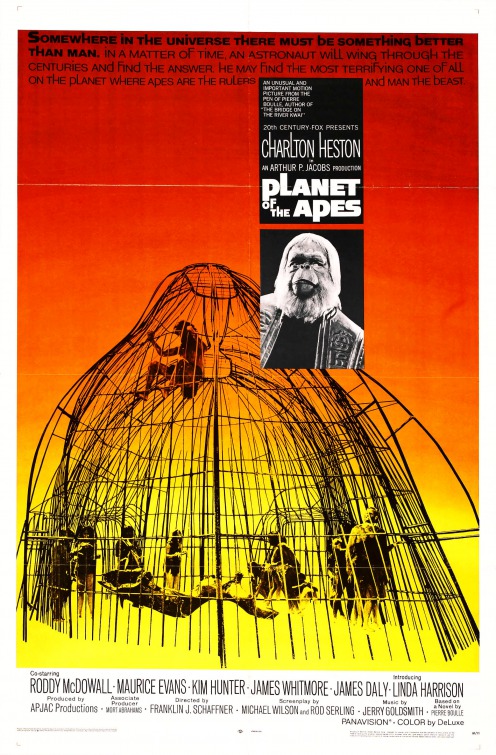
I had a blast watching the original PLANET OF THE APES on the big screen at the Paramount last night. Charlton Heston was a honey-baked ham of an actor but he's great in this genre classic. Here are my thoughts and memories of this durable film and the industry it spawned.

The first time I heard about a movie called PLANET OF THE APES was seeing the one-sheet poster in the lobby of the State Theater on Congress Avenue. The year was either 1967 or 1968. There was no Internet then, no readily available source for news and information about upcoming movies. Our one source for the straight dope on new "monster" movies was FAMOUS MONSTERS. I do recall that Forry Ackerman ran some articles about the film (although the original film wasn't cover featured, that honor fell to BENEATH THE PLANET OF THE APES). But I remember that these articles, which focused mainly on the amazing make-up by John Chambers, ran after I had already seen the film.

I saw PLANET OF THE APES as a first run film at the State Theater. It blew my mind. I never saw that ending coming. It stayed with me for days. I decided to read the novel (originally published as MONKEY PLANET) by Pierre Boulle. I struggled my way through most of it but it was so totally different than the movie (and slightly over my seventh-grade reading ability), that I didn't enjoy it. I have a copy of it on my shelf and one of these I'm going to tackle it again and read it from an adult perspective.

Oddly enough, there never was a comic book adaptation of PLANET OF THE APES published when the film was new. Dell and Gold Key Comics both did regular comic book adaptations of films and they were usually pretty good. Gold Key did publish a comic book version of BENEATH THE PLANET OF THE APES and that issue is a highly-prized collector's item, especially if it still contains the poster that was originally included within the comic.

Marvel Comics acquired the rights to publish a POTA black-and-white magazine in the mid-'70s. This magazine, which sported gorgeous painted covers, ran an original story set on the Planet of the Apes in the front of the book, several articles about the films and graphic adaptations of the original films. Finally, a comic book version of the original POTA, with art by one of my favorite comic book artists, George Tuska.

Of course, we can't forget KAMANDI, THE LAST BOY ON EARTH,  the post-disaster science fiction comic book series that Jack Kirby produced for DC Comics. It's a terrific series, full of high adventure and wild concepts and it was clearly inspired by the success of the POTA films (see the cover of the first issue!). Kirby is my all-time favorite comic book artist and I love everything he did. KAMANDI, which is currently being published in handsome hardcover collections, is highly recommended.

Meanwhile, back at the movies. The POTA cinematic franchise continued with BENEATH THE PLANET OF THE APES. I saw this one at the old Fox Theater on Airport Blvd the summer it was released. I was in junior high at the time and it was a big deal, a highly anticipated movie event which should have written an end to the series (the planet is destroyed at the end of the movie). But the box office take was too good to stop making monkey movies and a third film, ESCAPE FROM THE PLANET OF THE APES was produced.

In this one, Zira and Cornelius escape the destruction of the planet at the end of BENEATH in a spaceship that takes them back to present day earth where their child, Baby Milo, becomes the progenitor of the whole intelligent ape species. Just thinking about this time paradox makes my head hurt. I didn't see ESCAPE at the theater. Instead, I caught it one Friday night on the CBS LATE MOVIE.

Two more films followed, CONQUEST OF THE PLANET OF THE APES and BATTLE FOR THE PLANET OF THE APES. My interest in POTA had pretty much died by the time these lesser efforts were released and to this day, I've never seen these films in their entirety. I do recall that all five APES films used to run in dusk-to-dawn marathons at drive-in theaters (remember them?) around town. They were promoted with the tag line "Go Ape!" but I never worked up the enthusiasm to sit through them all.

There was an animated POTA Saturday morning cartoon series that ran on NBC for one season and I remember seeing a few episodes. And there was a prime time POTA series on Friday nights on CBS but I don't think I ever watched it. POTA also spawned model kits, action figures and other toys (which are highly prized by fans) but I never bought any of them.

My closest brush with POTA fame and fortune came at one of the first comic book conventions held in Austin in the late '70s. These conventions were the brainchild of Jay Knowles, who owned and operated the first back-issue comic book shop in Austin, the legendary N.E. Mercantile Company. The store was housed in a small building on North Lamar right next door to the fabled Terminex Bug building (it was across the street from the Tavern at 12th at Lamar).

The first few conventions were held at the old Gondolier Hotel (Riverside and IH-35). I volunteered to work at the cons and I had a great time. A featured guest one year was a stunt man (and forgive me, I don't recall the gentleman's name), who had worked in POTA as a gorilla solider. He still had the long sleeved tunic, the leather vest, the bandolier, the pants, the two-toed boots and braided leather whip that he used in the film and he brought them with him to the convention. He also had a mass produced POTA gorilla full-head mask.

I forget whose idea it was but at some point it was decided that I should don this get up and wander around the hotel giving guests ape attitude as a swaggering gorilla enforcer. Believe it or not, the clothes all fit me then and the stunt man blackened up the areas around my eyes and my neck and slipped the mask over my head. I must confess, I made a pretty good gorilla and for a brief time, I wore a costume that was actually used in the film.

I recall hanging out with the stunt man by the pool later, drinking beer and listening to  stories about his career. If anyone reading this can recall this gentleman's name (I seem to remember that he was later killed while performing a stunt in a film), please let me know. He deserves to be properly remembered.

The gorilla suit wasn't my only brush with playing dress-up at one of those comic book conventions. At the next year's con, I was coerced into wearing a full-body Godzilla suit that someone had made out of foam rubber. I had to strip down to my tighty-whiteys to get into the thing, which was like wearing a full body sauna. I had to have help walking around the convention (I could hardly see anything out of a small slit in the neck) and by the time I got out, I was soaking wet with sweat. I don't know who wore the suit after me but I sure hope they gave it a good hosing down.

Friday, August 17, 2012

STEVEN SPIELBERG TRIVIA TEXAS STYLE


Steven Spielberg shot one movie in its' entirety within the great state of Texas. He also shot one scene (and one scene only) in Texas for another movie. Can anyone name these two films?

Thursday, August 16, 2012

FORBIDDEN PLANET/METROPOLIS

I'm going to introduce the double feature of FORBIDDEN PLANET and METROPOLIS (the 1980s Giorgio Moroder version) at Stateside at the Paramount tonight at 7:15. Come on down and check out these two classic science fiction films.

Wednesday, August 15, 2012

THE PROWLER


Just as there is "no crying in baseball", there is no perfect crime in film noir. That's what Van Heflin learns the hard way in THE PROWLER (1951) which I watched last night.

A woman (Evelyn Keyes) sees a prowler outside her Los Angeles home and calls the police. Two uniformed officers arrive to investigate. One of them is Heflin who, right from the start, you can tell is a bubble off plumb. The woman is home alone every night while her husband works as a disc jockey for an all-night radio program. Heflin likes what he sees in the attractive blond and he pays a follow up visit without his partner.

He quickly comes on to Keyes and although she at first refuses his advances, she ultimately gives in. They begin an illicit and torrid affair but the husband soon starts to suspect and quits his job to stay home with his wife. What to do?

Playing on the fact of the previous prowler call, Heflin stages a break-in at the house, knowing the husband will investigate. He does and Heflin guns him down but arranges things to look like an accidental homicide. At the following police inquest, Heflin is acquitted of any wrong doing and the path to the new widow Keyes is now open to him.

Keyes believes his innocence and the two marry and move to Las Vegas where they buy a motor court. But she has some unexpected news for Heflin that causes his carefully laid plans to suddenly start to fatally unwind.

From the streets of Los Angeles to a dramatic climax in the high desert, THE PROWLER is a spare, taut little masterpiece. Joseph Losey directed the film from a screenplay (uncredited) by Dalton Trumbo. Oddly enough, both men were later blacklisted in the Hollywood witch-hunts of the '50s. Losey moved to England and made films there for the rest of his career. He never returned to the United States. Trumbo was out of official screenwriting work for many years although he did write material that was submitted under other names. It would be years before a screenplay credit with his name would appear on a Hollywood film.

THE PROWLER has been championed by James Ellroy, the dean of hard boiled American crime fiction and the film has undergone a complete digital restoration courtesy of the UCLA film school.

I had never seen this film, much less even heard of it, until I chanced to see the listing for it on Turner Classic Movies. It sounded interesting so I recorded it and watched it last night. I'm glad I did. It's a top-notch noir and highly recommended. Check it out.

THE BEAST FROM 20,000 FATHOMS and THE DAY THE EARTH STOOD STILL


Tonight is the last night to catch this classic 1950s science-fiction double feature at the Paramount Theatre. If you can't make it to the show, here are my film notes to enjoy.

The 1950s were the one, true Golden Age of American science fiction films. More films in this genre were produced during this time period than any before or since. And with good reason. Science fiction cinema was the perfect tabula rasa upon which to project the zeitgeist of the era. The heady optimism of the nascent space race was reflected in such films as Destination Moon (1950), Flight to Mars (1951) and Rocketship X-M (1950), among others.

But it wasn’t all sweetness and light. Fear and paranoia of various kinds informed a number of other films. The newly harnessed power of the atom, while capable of providing good in the form of energy, could also result in death and destruction on an unprecedented scale, as was recently witnessed first-hand in the 1945 atomic bombings of the Japanese cities of Hiroshima and Nagasaki at the end of World War II. And it was the atom run wild that created so many memorable giant beasts in such classics as Them! (1954), The Beginning of the End (1957), Tarantula (1955), The Deadly Mantis (1957) and The Amazing Colossal Man (1957), among many others.

America was involved in a Cold War with the Soviet Union and the fear of being invaded, either by forces from without or from within was shown in The War of the Worlds (1953), Invaders From Mars (1953), The Thing (From Another World) (1951) and Invasion of the Body Snatchers (1956). To be sure, there were countless cheap, exploitative films produced during this time as well. But even when hampered by budgetary restrictions, some of them at least tried to address these issues (and others) in a sub-textual way without interfering with what really sold tickets: spaceships, flying saucers, alien beings and mutated monsters. Two of the all-time best science fiction films of the 1950s are on display here.

Though it lacks any CGI special effects (which the execrable 2008 remake was chock full of), Robert Wise’s masterpiece The Day the Earth Stood Still ranks as one of the greatest science fiction films of all time. Soberly, almost solemnly, it depicts the arrival of an alien dignitary, the enigmatic Klaatu (Rennie), who has come to earth along with his implacable giant robot Gort (Martin), to deliver a message. Klaatu calls the world’s leaders to Washington, D.C. (where his saucer has landed), but while they squabble amongst themselves, he goes about the human race incognito to discover why humans can’t hear the truth. He is aided in his quest by a young widow (Neal) and her son (Gray), both of whom come to have real feelings for the alien.

Wise orchestrates the action in a very realistic manner and the special effects are effective and convincing. Michael Rennie, in one of the most iconic performances in the genre, is superb as the Christ-like alien who dies and returns to life before ascending back into the heavens from whence he came. Gort is suitably menacing and the eerie score by maestro Bernard Herrmann is unforgettable. And finally, the message of the film, live in peace or face utter annihilation, is as resonant now as it was then. Science fiction films rarely get any better than this intelligent and literate classic. Gort, Klaatu Barada Nikto!

Ray Harryhausen is the only special effects technician in the history of film to rightly be called an auteur. Harryhausen’s science fiction and fantasy films all bore the stamp of his signature work: eye-popping, jaw-dropping stop-motion animation. Forget computers. Harryhausen did it the hard (and best) way: by hand. Every one of his miniature models were uniquely and elaborately designed to move. Using an armature of wire and meta, with ball and socket joints and a covering of rubber or fur, Harryhausen’s creations came to life under his expert, skilled hands as living, breathing, moving, real flesh and blood, three-dimensional characters. And that’s what his creatures were, characters, not just special effects. Each one had a personality and distinctive mannerisms that made them all unforgettable.

Stop-motion animation is a painstaking process designed to try men’s souls and sanity. Each model is moved in minimal, micrometer measured increments. After each movement, one single frame of film is shot. Then the models are moved once again, ever so slightly and, again, a frame of film is exposed. When you consider that twenty-four frames of film equal one second of running time, you begin to comprehend the sheer magnitude of the task at hand. Once the models were put through their movements, the film was then composited into previously filmed scenes of live action with human actors. Matching the movements of monsters and men took almost preternatural skill, but Harryhausen appears to have it in is DNA. Working from illustrated storyboards done in pre-production, he knew exactly what each animated sequence should look like. The results were a seamless blend of action, producing some of the greatest and most enduring images in the cinema of the fantastic.

Harryhausen worked with legendary stop-motion artist Willis O’Brien on Mighty Joe Young in 1949 before embarking on his first solo effort for Warner Brothers in 1953. The Beast from 20,000 Fathoms was loosely based on the short story “The Fog Horn” by Harryhausen’s boyhood pal, Ray Bradbury. Both men shared an intense passion for all things dinosaur and that love is clearly on display in this film. An atomic blast (what else) thaws out and reawakens a prehistoric monster dubbed a rhedosaurus. The monster, superbly animated by Harryhausen, makes its’ way down the east coast of the United States and begins wreaking havoc in New York City. The beast is finally destroyed in a spectacular, fiery climax at Coney Island amusement park.

It’s a simple story but it’s extremely engaging. Genre icon Kenneth Tobey (The Thing, It Came From Beneath the Sea (1955) is on hand and future bad guy Lee Van Cleef is the sharpshooter who figures in the beast’s demise. Harryhausen moved to Columbia Pictures for the next phase of his career where he made three more ‘50s science fiction landmarks: It Came From Beneath the Sea, Earth vs. The Flying Saucers (1956) and 20 Million Miles to Earth (1957).

Monday, August 13, 2012

THE GOOD WAR ARTIST


Back in the '40s,'50s and '60s, Carl Barks drew hundreds of stories featuring Donald Duck, his three nephews and Uncle Scrooge McDuck for various comic books published by Dell and Gold Key. He was a superlative artist but those comics didn't run creator credits for writers, artists, inkers, letterers and colorists like today's books do. Most of us kids who read those comics didn't know who Barks was by name, but we knew his work by sight. He was quite simply "the good duck artist."

Joe Kubert didn't create his brilliant comic book art anonymously over his astonishingly long and remarkably rich career. He signed both his cover and interior art in many instances and his style was unmistakable. And for this child of the '60s, Joe Kubert was "the good war artist."

If Joe Kubert had only ever illustrated the long-running Sgt. Rock series that ran in DC Comics' OUR ARMY AT WAR, his place in comic book history would be assured. The Sgt. Rock series, written by Robert Kanigher and beautifully illustrated by Kubert, is top-flight work depicting men achieving heroic and noble deeds amid the horrors, the stress, the insanity of war. Sometimes just surviving was enough. Sgt. Rock and his men in Easy Company never stopped fighting the good fight. Rock fearlessly led his men into danger and even though the ultimate price was sometimes paid by one of his troops, Rock somehow was still standing when the battle was done.

But Joe Kubert was far more than Sgt. Rock. Over the course of a career that began when he was a teenager in the late '40s, Kubert worked for a variety of publishers before finding a permanent home at DC Comics where, in addition to Rock, he pencilled such first rate series as The Viking Prince, Enemy Ace, Hawkman, Firehair, Ragman, Tor and more.

Kubert's Enemy Ace series (which began as a backup in OUR ARMY AT WAR, was then tried out in SHOWCASE and finally earned a home in STAR-SPANGLED WAR STORIES) was groundbreaking, daring and revolutionary. Who would dare show WWI through the eyes of an enemy combatant? Kanigher and Kubert, that's who in a spectacular series that captured the balletic aerial combat of biplanes in the skies and the grim reality of No Man's Land on the ground. A German ace seemed an unlikely hero for a war comic but Kanigher and Kubert invested Hans Von Hammer with an air of nobility, pride, courage and fierce grace. All of the Enemy Ace stories are outstanding and well worth checking out.

When legendary editor Julius Schwartz was re-imagining the Golden Age DC heroes for the new Silver Age (a name which did not exist at the time) of comics, he tapped Joe Kubert to breathe new life into Hawkman. In the old days, Carter and Shiera Hall were archaeologists who fought crime as Hawkman and Hawkgirl. In the new iteration, Katar and Shayera Hol were alien police officers, sent to earth from the planet Thanagar, to observe our law enforcement system. Kubert gave us a firmly muscled, lean fighting man in Katar and a smoking hot redhead in Shayera. The duo took to the skies, armed with ancient weaponry, to fight a variety of menaces. The series mixed superhero action with science fiction tropes and Kubert brought it all to vivid, gorgeous life. The new Hawkman series ran as a try-out in THE BRAVE AND THE BOLD before eventually earning its' wings (sorry) and moving into HAWKMAN in 1964. When Katar and Shayera got their own book, the art chores were handled by Murphy Anderson, a very, very good artist but one whose style was vastly different from Kubert's.

Kubert's other magnum opus was TARZAN. When DC acquired the rights to publish the adventures of Tarzan and his son Korak (along with other heroes) from the Edgar Rice Burroughs estate in the early '70s (the series had previously been published by Dell and Gold Key), Kubert was put in charge of the Ape Man as writer/artist/editor. He faithfully adapted several of the ERB novels into comics form and his work ranks as some of the best interpretations of the character ever put on paper.

Kubert's art was at times sketchy and slightly unfinished looking. He often used silhouettes of figures in the foreground with more fully rendered backgrounds. But he was a consummate storyteller and he drew characters that were lean, sinewy, wiry and tough. His men were well muscled and powerful looking without being muscle bound, steroidal superheroes. Kubert could also draw beautiful women and any comic book with Joe Kubert artwork is worth reading.

The amazing thing about Joe Kubert was that he kept working right up until the end of his life with no drop off whatsoever in terms of quality and style. He was as good last year as he was twenty, thirty, forty years ago. Joe Kubert was one of the greatest comic book artists of all time.

And now he is gone. And with his passing yet another part of my childhood goes with him.

But weep not for this fine soul. Joe Kubert lived a long and incredibly productive life and almost all of his work is still in print and readily available to be enjoyed, savored and thrilled to time and time again. Rest in peace and go with God my good man. I will miss you but I will always treasure your work and the wonderful times I've had in my life while reading comic books drawn by "the good war artist".

Sunday, August 12, 2012

A VERY WORTHY CAUSE

I'm selling tickets to the annual pancake breakfast and silent auction fundraiser to benefit the Texas Baptist Children's Home. The event is sponsored by the Round Rock Noon Kiwanis Club, of which I am a proud member. The breakfast will take place at the TBCH on Saturday, September 29th from 7:00 a.m. to noon. Tickets are only $5.00 and all proceeds benefit TBCH. If you'd like to purchase a ticket from me, send me an email at docsavag@austin.rr.com and I'll give you more information.

My father and my grandfather were both active in Kiwanis and I'm proud to carry on that tradition as a third generation Kiwanian. In addition to the Texas Baptist Children's Home, the Round Rock Noon Kiwanis Club supports the YMCA of Williamson County, the Williamson County Health Department, the Alzheimer's Association, Books for Kids, Capital Idea, the Starry Project, the Linus Project, Round Rock Family Night, Round Rock High School Scholarship, Stony Point High School Scholarship, the Agape Pregnancy Center and Park for All Abilities.

I hope everyone who reads my blog will consider buying a ticket even if you can't make it to the breakfast. The money goes to a very worthwhile cause and I won't ask my dear readers to support a fundraising event like this again until next year's breakfast.

Thanks!