 |
Believe it or not, I've never seen Stanley Kubrick's 1956 film noir masterpiece THE KILLING. It's one of those films that I've heard nothing but good things about but somehow, I've managed to miss it for all of these years. The film stars noir icons Sterling Hayden, Marie Windsor, Elisha Cook, Jr., and Timothy Carey. It's part of the Criterion Collection and I just might have to treat myself to a Blu Ray copy sometime in the near future.
Until then, I'll have to make do with the source material. I've had a copy of the Black Lizard paperback edition of THE KILLING on my shelf for years. I ran across it the other day and decided to give it a try. Lionel White's 1955 novel, originally published under the title CLEAN BREAK is an astonishingly accomplished caper novel that moves faster than a thoroughbred coming into the home stretch.
Ex con Johnny Clay is the mastermind behind a brilliant and daring race track robbery. He assembles a team of non-professionals to aid in his scheme. The group includes a bent cop, a track cashier, a bartender and a policy writer. The plan is foolproof but, as always, things go wrong.
A mobster gets wind of the job through one of the gang member's cheating tramp of a wife and decides to go after Johnny and his men after they've executed the heist. There's a violent showdown at the end of the book between the two gangs and a stinger of an ending on the last page.
White tells his story using multiple points of view, getting inside the heads of various characters. And he brilliantly fractures space and time in the last third of the novel, bouncing back and forth in time as various events play out at the race track.
Lean, tough, swift and brutal, THE KILLING is exactly the kind of crime novel I dig. Loved this book! Can't wait to see the movie.
|
Saturday, September 21, 2019
THE KILLING

Saturday, August 3, 2019
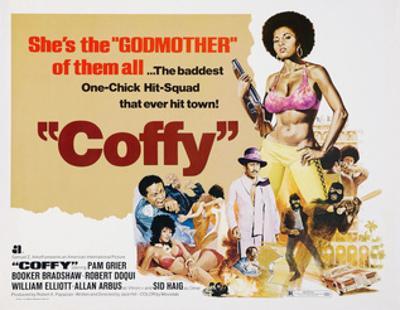
COFFY
 |
Regular readers of this blog know that I am a big fan of "blaxploitation films", the sub-genre of exploitation cinema that flourished during the 1970s. While I haven't seen every blaxploitation film made during that era, I've thoroughly enjoyed the films I have seen. These movies take me back to my high school years with vintage cars, clothes, music, really bad guys, beautiful women and tons of "R" rated violence. These films were staples on both the inner city grindhouse circuit as well as the suburban drive-ins that were still in operation.
COFFY (1973), which I watched for the first time yesterday, shows exploitation auteur Jack Hill at the top of his game in this violent actioner about a woman out to get revenge. Coffy (Pam Grier), is a nurse at a major metropolitan hospital (the city is never actually named but it's clear it's Los Angeles), whose little sister has become a heroin addict. The girl is in a rehab clinic but the prognosis for recovery doesn't look good. Coffy decides to seek out and kill all of the men responsible for her sister's condition.
And that's just what she does. Coffy is not a police officer, a military veteran or a government agent of any sort. She's a fiercely determined and driven young woman who will stop at nothing to get the evil men who have hurt her sister.
Coffy enters a sleazily underworld of pimps, prostitutes, drugs, mob hit men (including the great Sid Haig), crooked cops and corrupt politicians. The bad guys try to stop her several times using a variety of methods of mayhem but Coffy keeps on fighting. Hand guns, shotguns, sharpened hair pins, razor blades and various vehicles are all instruments of massive carnage throughout the film. At the end, all of the bad men have been dispatched, even a man Coffy loved.
Nothing trumps revenge.
Pam Grier, who had previously appeared in Hill's women-in-prison picture THE BIG DOLL HOUSE (1971), owns this movie from start to finish. With little formal acting training or experience (she was a receptionist at American International Pictures when Hill spotted her and cast her), Grier exudes star power in every frame. She's a beautiful, smart and competent young woman, no shrinking damsel in distress who must be rescued by a more capable man. She kicks ass and takes names and in the process, became an icon of 1970s blaxploitation cinema. Coffy as a character and Grier as an actress, both became positive role models for independent, strong women in a genre and industry dominated by men. Sure it's a low budget B movie but COFFY is nonetheless an important film from the break-all-the-rules cinema of the 1970s.
Highly recommended.
|
Friday, July 26, 2019
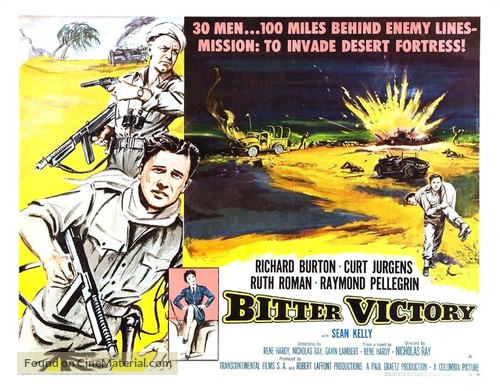
BITTER VICTORY
 |
American director Nicholas Ray would, at first glance, seem to be a rather curious choice to helm a World War II action film. Better known for such classics as THEY LIVE BY NIGHT (1949), IN A LONELY PLACE (1950), ON DANGEROUS GROUND (1952), MACAO (1952), REBEL WITHOUT A CAUSE (1955) and BIGGER THAN LIFE (1956), Ray did have one war movie, FLYING LEATHERNECKS (1951) under his belt. And a Nicholas Ray directed war movie is bound to be something different from the usual run of the mill fare.
BITTER VICTORY (1957) is the story of two men, Major David Brand (Curt Jurgens) and Captain Jim Leith (Richard Burton) who clash in North Africa during WWII. As it turns out, Leith, a combat veteran, had a brief but torrid affair with Jane (Ruth Roman), before she married Brand. Leith still carries a torch for Jane and she is still romantically attracted to the dashing young soldier.
The British high command orders a commando raid on Benghazi to capture Nazi documents stored there. It's a dangerous mission but Brand, with no field experience, is given command of the operation due to his seniority and rank. Leith is assigned his second in command. The rest of the squad is composed of veteran British actors including Nigel Green and Christopher Lee.
Ray wastes no time in getting the men to their objective where Brand freezes under stress, unable to kill a German sentry. It's up to Leith to do the dirty work and the operation continues. The men get the documents as ordered and put their escape plan into action. But the camels that were supposed to carry the men back to the rendezvous point don't show up, forcing the men to set off across the North African desert on foot.
They're ambushed by a Nazi patrol and a vicious gun battle leaves most of the Germans dead except for Colonel Lutze (Fred Matter), whom the commandos take prisoner. Brand is clearly in over his head and he depends upon Leith to make the hard decisions. But when Brand sees a scorpion about to attack Leith, he does nothing to interfere, letting the man be stung, becoming unable to continue the journey. When a fierce sand storm erupts, it's Leith that saves Brand from certain death, dying in the process. The rest of his men believe Brand killed Leith and view him with suspicion for the rest of the trek.
The men finally meet up with British forces but while celebrating, they ignore Colonel Lutze who puts the bags containing the documents to the torch. Only one bag is able to be salvaged but it's enough for Brand to be recognized as a hero by the British top brass and awarded a medal for heroism under fire, a medal he most certainly doesn't deserve.
BITTER VICTORY is an interesting, offbeat and first rate little war movie that is unflinching it depicting some rather atrocious war crimes (on both sides). Burton and Jurgens seem to genuinely hate each other while Roman harbors deep feelings for both men. Cynical and uncompromising, BITTER VICTORY is well worth seeing for fans of Nicholas Ray and World War II films.
Recommended.
|
Wednesday, July 24, 2019
GRACE
 |
Somewhere between Roman Polanski's masterpiece of urban horror, ROSEMARY'S BABY (1968) and the over-the-top insanity of Larry Cohen's monster baby epic IT'S ALIVE (1974) lies GRACE (2009). This low budget, independent Canadian horror film borrows a great deal from the body horror oeuvre of fellow Canadian David Cronenberg in it's depiction of motherhood gone horribly wrong.
Madeline (Jordan Ladd), is a pregnant young woman whose husband, Michael (Stephen Park), dies in a car accident before the baby is born. The accident also leave the baby dead but Madeline decides to let the corpse go full term and be delivered anyway, telling everyone that the infant died at birth. But somehow, the baby girl named Grace, comes alive after delivery. Is it a miracle? Or something far more sinister.
It's the sinister option, of course, with young Grace refusing to accept breast milk in lieu of something else: blood. And not just any blood as Madeline finds out when she tries to feed Grace blood drained from fresh cuts of meat. No, little Grace demands human blood and she ravenously takes it from her anemic mother. Madeline is soon forced to find a supply of human blood that doesn't involve the ravaging her nipples and breasts. She finds that source in the form of a meddling Dr. Sohn (Malcolm Stewart) and Vivian (Gabrielle Rose), her grief stricken mother-in-law. But by then it's too late as Madeline herself has succumbed to the curse of needing human blood herself. And things ratchet up another notch in the last scene of the film when young Grace starts teething, implying a need for both blood and flesh.
GRACE is a very well made little shocker which touches on some extremely disturbing themes and many "really-wish-I-hadn't-seen-that" scenes of shockingly intimate blood and gore. Not for the faint of heart, GRACE is a slowly building exercise in maternal terror and dread with no explanation given for why this living dead baby has come to be. She simply is and Madeline will do anything to protect and provide for her.
This film is certainly not every one's cup of tea but for fans of modern, independent horror films, GRACE is definitely worth seeing.
|
Tuesday, July 23, 2019
WHITE ZOMBIE
 |
Universal wasn't the only Hollywood studio producing horror films in the 1930s. Paramount gave us ISLAND OF LOST SOULS in 1932, while Warner Brothers, known primarily for their hard boiled gangster dramas, released THE MYSTERY OF THE WAX MUSEUM in 1933 (and in early two-strip Technicolor).
Although released by United Artists, WHITE ZOMBIE (1932) was actually an independent film produced and directed by Victor and Edward Halperin (respectively). Without a major studio pedigree, WHITE ZOMBIE sort of got lost in the pre-code horror film shuffle, despite a terrific starring turn by genre icon Bela Lugosi. Following his star making appearance in Tod Browning's DRACULA (1931), Lugosi was featured in another Universal horror film, MURDERS IN THE RUE MORGUE (1932) before being cast by the Halperins as the zombie master "Murder" Legendre in WHITE ZOMBIE.
Lugosi, with his weird "zombie grip" (actually, an early form of isometrics exercise) and his penetrating gaze (there are numerous closeups of his hypnotic eyes), commands the film. A severe widow's peak, mustache and goatee lend him a decidedly Satanic countenance as the commander of an army of zombies sent out to do his unholy bidding.
Madeleine Short (Madge Bellamy) and her fiance Neil Parker (John Harron), journey to Haiti to be wed. Once there, they quickly encounter a native burial ceremony and the mysterious Legendre. Plantation owner Charles Beaumont (Robert W. Frazier), falls madly in love with Madeline and begs her to marry him instead of the steadfast Neil. Madeleine refuses and Beaumont, who already uses the living dead as slave labor in his sugar cane mill, turns to Legendre for help. But Legendre has plans of his own for the beautiful Madeleine and turns her into the "white zombie" of the title to satisfy his own unspeakable desires.
Neil and Dr. Bruner (Joseph Cawthorn), join forces to rescue Madeleine from the clutches of Legendre and return her to the land of the living.
Shot in only eleven days and with a running time of just over an hour, WHITE ZOMBIE packs an undiluted punch of pre-code horror. While not as well known as its' big studio brethren, ZOMBIE is nonetheless an extremely effective horror film unitizing stellar camera work by Arthur Martinelli, impressive sets (left over from larger productions), matte paintings, angular scene "wipes", a leavening of sly humor, a decidedly twisted sexual undertone and an overall sense of dread and foul deeds. Lugosi delivers a first rate performance while the rest of the cast varies in acting ability.
But the film moves fast enough that you're never bored or too strongly put off by some of the lesser thespian talents on display here. The goal of WHITE ZOMBIE is to tell a compelling story about ancient rites and superstitions, which may or may not be supernatural in origin and it succeeds admirably.
I hadn't seen this film in close to twenty years so watching it this afternoon with my buddy J. Aaron, was a real treat. It may not rank among the Universal horrors of the thirties as a favorite but it is certainly a solid, genuinely creepy minor masterpiece.
Highly recommended.
|
Monday, July 15, 2019
ANOTHER SON OF SAM
 |
Rescued from oblivion by Austin based AGFA (American Genre Film Archive, and now you know whom to thank or blame), ANOTHER SON OF SAM (1977) is one of those craptastic pieces of exploitation cinema that has to be seen to be believed.
Shot with all of the visual style and panache of the worst driver's ed film (were there any good driver's ed films?) you sat through in junior high, ANOTHER SON OF SAM looks like it was made by someone who, quite possibly, had never actually seen a real movie before lensing this masterpiece.
That someone is one Dave A. Adams, a jack-of-all-trades who served as the director, writer, producer, film editor, stunt coordinator and casting director for the film. I think it's a safe bet to assume that good ol' Dave also made the bologna sandwiches that he fed to his hopelessly inept cast and crew.
The cast, by the way, looks like it was composed of either both the in-front-of and behind-the- camera talent from a local television news department or actors from a third rate community theater.
The film opens with a series of slides documenting famous serial killers throughout history. By the way, Jack the Ripper only killed five women, not the 15 stated on screen. And since notorious serial killer, David Berkowitz, the so-called "Son of Sam" killer had recently finished his legendary killing spree in New York City, it of course makes perfect sense to entitle the film ANOTHER SON OF SAM, even though the film has nothing whatsoever to do with Berkowitz.
In an interminable 77 minutes of running time, one-time-only auteur Adams delivers the story of Harvey, a disturbed young man who was, believe it or not, raped by his mother when he was young. Harvey, a patient in a mental hospital, kills two aides and gravely injures his consulting psychiatrist and then escapes to a nearby college campus, where he kills more people before finally hiding out in an empty girls' dormitory.
Although a title card at the beginning of the film states that it's early summer when the action takes place, when Harvey takes up residence in the dorm, it's empty because it's spring break. Come to think of it, KILLER IN A GIRLS' DORMITORY would have made a better title than ANOTHER SON OF SAM. After all, there was the 1961 classic WEREWOLF IN A GIRLS' DORMITORY and who can forget my all-time favorite children's book, CURIOUS GEORGE IN THE NURSES' DORMITORY?
I digress.
The local cops aren't up to the task of confronting Harvey with their meager resources so they call in a SWAT team from the nearby big city. Remember folks, SWAT stands for "Special Weapons And Tactics" but this group of Keystone Cops are more like "Special Needs Weapons and Tactics". Other than nifty ball caps, bulletproof vests and assault rifles, these dolts have absolutely no clue or plan for how to get rid of Harvey.
Oh, and remember how it was clearly stated earlier that the dormitory was empty? Turns out it's not. Two girls from earlier in the film are somehow, inexplicably still in their dorm room after the building was supposed to have been cleared by the police.
Finally, the cops decide to send Harvey's mother (!) (whom he hasn't seen in years), into the dorm to see if she can convince her crazy son to surrender. The two square off, there's a sudden jump cut/splice and somebody (we're never shown if it's his mother or the police), fires six shots into Harvey, bringing his rampage to an end.
But wait, there's more. Director Adams shoots multiple scenes with an extremely shaky hand held camera to represent Harvey's point of view. Harvey himself is only seen in extreme close ups spotlighting his manic eyes and his totally out of control hairy eyebrows. I suspect those closeups may be of Adams himself. Scenes end abruptly with a freeze frame of the action while the post dubbed dialogue continues. One cop gets gunned down at point blank range yet we see no blood or bullet effects, However, when Harvey is hot, he's an absolute bloody mess.
There's also a pointless scene early in the film featuring a horrible lounge singer (complete with shirt open to his navel) singing a song in a local nightclub (the club is acknowledged during the opening credits). The college girls, however, are cute and remind me very much of girls I knew when I was in college, which just happened to be in 1977, the year this monstrosity was made.
So bad it wasn't released, it escaped, ANOTHER SON OF SAM is recommended to all connoisseurs of truly terrible cinema. Everyone else should avoid this one like the plague.
|
Saturday, July 13, 2019
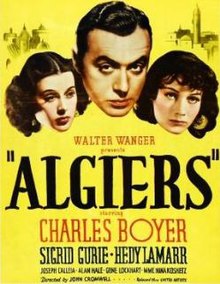
ALGIERS
 |
Like millions of other fellow baby boomers, I grew up watching the classic Warner Brothers' Looney Tunes and Merrie Melodies cartoons on television. The films were constantly shown on all three networks on Saturday mornings, endlessly repackaged (and, alas, edited). I watched them all and loved them all. My favorite Warner Brothers cartoon character was (and still is), Foghorn Leghorn. But I digress...
One of the characters featured in these films was Pepe Le Pew, an amorous (and odorous) French skunk who was constantly in search of love. Pepe, created by legendary animation directors Chuck Jones and Michael Maltese, made his debut in 1945 and starred in 18 cartoons between that year and 1962. But one cartoon in particular, THE CAT'S BAH (1954), stood out from all of the rest.
Here, Pepe channeled the voice and personality of actor Charles Boyer in an animated riff on the classic film ALGIERS (1938). I had no idea that this cartoon (and it's signature line of dialogue "come with me to ze Casbah") was based on an old movie. But the audiences of the time surely recognized the reference, which only added to the overall cleverness of the character and his milieu. I had no clue that a film called ALGIERS existed, nor did I know who Charles Boyer was. All I knew was that the cartoon was funny and made me laugh every time I saw it.
For the record, at no point in the 99 minutes of ALGIERS does Boyer ever utter the deathless phrase "come with me to ze Casbah." That's mainly because he's already in the Casbah, that area of Algiers that sits above the city proper and serves as a fortress for thieves and all sorts of illicit and illegal activities. ALGIERS is a remake of the 1937 French film PEPE LE MOKO, with Boyer playing master thief Pepe. He and his gang of thieves (which includes veteran character actor Alan Hale), operate with impunity within the limits of the Casbah, a labyrinthine maze of twisting, narrow alleys and connected rooftops which allow escape from the police when necessary. Pepe may be king of this North African underworld empire but he's also a prisoner. To leave the confines of the Casbah and enter the streets of Algiers proper will surely end in his capture and possible death.
Pepe's main love interest is the smoking hot Ines (Sigrid Gurie) but she's soon eclipsed when Gaby enters the scene. Gaby, played by the astonishingly beautiful Hedy Lamarr in her first American film, comes to the Casbah dripping with jewels, gifts from her much older (and extremely wealthy ) fiance. Pepe is immediately attracted by the diamonds and pearls Gaby wears but soon becomes smitten with the woman herself. The two yearn to run away together back to Paris where they hope to find happiness.
Alas, it is not to be.
ALGIERS is skillfully mounted by director Enter John Cromwell with sinuous camerawork by the legendary James Wong Howe. Howe shoots the Casbah in cramped, low angle compositions, underlining how trapped Pepe is by both his lifestyle and his choice of living quarters. Intrigue abounds, with plots and schemes to capture Pepe launched by both crooks and cops, each meting with failure until the very end of the film.
ALGIERS clearly served as inspiration for CASABLANCA (1942). While it doesn't reach the heights of that masterpiece, ALGIERS is nonetheless a very impressive film. Boyer is at the top of his game, Lamarr is simply breathtaking and the story is fast moving and compelling. Plus, it's earned a place in the pop culture history of the twentieth century thanks to an animated cartoon skunk. Not many films can make that claim.
Recommended.
|
Subscribe to:
Posts (Atom)