 |
Today's short essay topic: describe how you would plan and execute a robbery of a casino ship in the middle of the Hudson river. You've got to get and getaway with over $300,000 in cold, hard cash. Oh, and security measures will not allow any guns to be brought on board. Ready? Go. That's the problem facing super thief Parker in BACKFLASH (1999), number 18 in the series of crime novels by Richard Stark (in reality Donald Westlake). I finished reading this one yesterday evening. It's one of those books where once I got to a certain point in the narrative, I absolutely could not stop reading. I inhaled the last one hundred pages in one sitting and believe me, I couldn't turn the pages fast enough. The book is divided into three acts. The first focuses on the planning of the heist and the recruitment of the players in the caper. The middle third is the actual execution of the robbery. It's an ingenious plan involving a fake politician and his two bodyguards, an invalid girl in a wheelchair and her chauffeur. The final act is the getaway which, in the tradition of all great caper stories, goes wrong when various outside players decide to cut themselves in for a piece of the action. It's up to Parker to tie up all of these loose ends and as he does so the body count starts mounting. BACKFLASH is wonderfully entertaining, a fast paced, gritty crime thriller in which we're solidly on the side of the bad guys. We want Parker and his gang to be successful and get away with the money but Stark has to put them through the wringer before it's all over. Highest recommendation. |
Wednesday, September 3, 2014
BACKFLASH

Monday, September 1, 2014
DARKMAN
 |
Hey kids! Let's play spot the influences in Sam Raimi's DARKMAN (1990), which I watched yesterday. This B-movie pulp adventure yarn is part classic Universal Studios monster movie, part Stan Lee-Jack Kirby Silver Age Marvel super-hero comic book. It's a wonderfully entertaining mash up that features nods to The Invisible Man, The Phantom of the Opera, Dr. X, The Shadow, The Incredible Hulk and The Chameleon (the old Spider-Man foe). Is it a great film? Hell no. But it is a ton of fun to watch. DARKMAN was director Sam Raimi's first big budget film for a Hollywood studio (appropriately, Universal). Raimi made a name for himself as a genre master with his break out hit THE EVIL DEAD in 1981, followed by CRIMEWAVE (1985), and EVIL DEAD 2 (1987). With DARKMAN, his fourth full length feature film, Raimi put his kinetic, over-the-top visual sensibilities on display in a tale of dark revenge. Liam Neeson (before he became a bonafide action film star) is a scientist experimenting with artificial flesh. His girlfriend, Frances McDormand, is a lawyer standing in opposition to a crooked real-estate developer played by Colin Friels (a dead ringer for University of Alabama head football coach Nick Saban). Larry Drake is Durant, one of Friels goons. In order to put the squeeze on McDormand, Durant and his men beat up Neeson and blow up his lab, leaving the good doctor for dead. That was their first mistake. Neeson survives the explosion but he's horribly disfigured. He somehow manages to salvage most of his lab equipment and, setting up shop in an abandoned foundry, sets out to put his artificial skin technology to use in exacting his revenge against Durant and his henchmen. There are some well-staged action sequences (including a helicopter chase with Neeson swinging on a cable beneath one of the choppers) before the final showdown at a construction site. At the end of the film, Neeson disappears into a crowd of people, dubs himself "Darkman" and appears on screen as Bruce Campbell (Raimi's go-to guy) in the final shot of the film. DARKMAN is all hyperbolic, pulpy fun. Produced one year after Tim Burton's seminal BATMAN (1989), DARKMAN employs a BATMANesque score by composer Danny Elfman. Raimi further cemented his reputation as a comic book film auteur with his three Spider-Man films: SPIDER-MAN (2000), SPIDER-MAN 2 (2004) and SPIDER-MAN 3 (2007). DARKMAN did well at the box-office, prompting a slew of spin-offs and tie-ins including a Marvel Comics series, video games and action figures. Two direct-to-video sequels followed, THE RETURN OF DURANT (1994) and DIE, DARKMAN, DIE (1996). I saw DARKMAN in the theater when it was first released and loved it. I hadn't seen it since then until I watched it yesterday afternoon when I enjoyed it again all over. Recommended for both horror film and comic book fans. |
Sunday, August 31, 2014
CITY LIGHTS
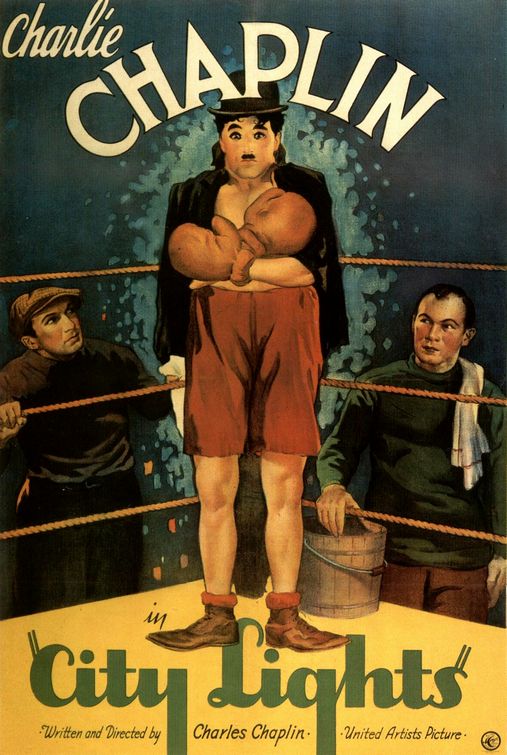 |
"Yes, I can see now." Judy and I watched CITY LIGHTS (1931) the other night. It was the first viewing of this classic film for both of us. We thoroughly enjoyed it. I don't know how I've managed to live this long without seeing this highly regarded film. But it certainly lives up to it's reputation as a masterpiece and one of Charlie Chaplin's greatest films. Although filmed in the early years of the sound era, CITY LIGHTS is basically a silent film. There is a score (composed by Chaplin) and sound effects but all of the dialogue is on inter title cards. The film is referred to as a "romance in pantomime" in the opening credits and it's as if Chaplin was refusing to abandon the media that made him an immortal. Chaplin (who also wrote, produced and directed the film) stars as the beloved Tramp. Here he falls in love with a beautiful blind flower girl (Virginia Cherrill). She thinks he's a millionaire and he goes to great lengths to maintain that persona and help the girl. The Tramp is befriended by an actual millionaire but they're buddies only when the rich man is drunk. When he's sober, he kicks the Tramp out. Forced to raise money for his love, the Tramp takes jobs shoveling manure (there's a great sight gag involving an elephant) and as a boxer (a delightfully choreographed fight sequence). But things take a turn for the worse when the Tramp is arrested for stealing money from the millionaire. He's innocent of course but he goes to jail anyway. While he's away, the blind girl has an operation to restore her sight and goes to work in a nice flower shop. When the Tramp is finally released from prison, he meets the flower girl once more and she realizes that not only is she seeing his physical appearance for the first time, she's also finally seeing his inner beauty as well. It's a terrific ending, one that's guaranteed to put a little lump in your throat to go along with the laughs provided in the rest of the film. Yes, CITY LIGHTS is as good as I've always heard it was. It certainly deserves it's reputation as one of the all time greats. But I still think that Buster Keaton's THE GENERAL (1927) is the greatest silent comedy film ever made. |
Wednesday, August 27, 2014
JUST CAUSE
 |
I stumbled across a used DVD of JUST CAUSE (1995) a few weeks back when Judy and I hit a local thrift store to do some bargain hunting. For 99 cents, I figured, hey, why not? I ponied up the money for only one reason: Sean Connery. I figured that anything with Connery in it is worth seeing at least once and besides, the price was definitely right for ol' skinflint Frank. Based on the novel of the same name by John Katzenbach (which I have not read), JUST CAUSE is the story of Paul Armstrong (Connery), a Harvard law professor and strong anti-death penalty advocate. After a public appearance in a small Southern town, Armstrong is persuaded by the mother of Bobby Earl Ferguson (Blair Underwood), to look into her son's murder trial, conviction and subsequent death penalty. She swears he's innocent. Armstrong is at first reluctant to take the case but once he starts digging around in the Florida town where the murder was committed (the victim was a young white girl), he comes to believe that his client, a well-spoken, highly intelligent young black man, is innocent. Armstrong soon uncovers evidence which indicates that insane serial killer and fellow death row inmate Blair Sullivan (Ed Harris), actually committed the crime. A new trial is held and Bobby Earl is found not guilty. He's released from prison while Sullivan is soon executed. End of story, right? Whoa, hold on there Tex. Not so fast. I can see by the old clock on the wall that we've still got about thirty minutes of running time left which means it's time for a major plot twist in the third act. I won't say what it is, but it's a fairly good one (if a bit contrived). As I said, you watch a routine, generic thriller like JUST CAUSE just to see the great Sean Connery in the twilight of his film career. Is it his best work? Far from it. But any Connery is better than none. Ed Harris does his best Hannibal Lecter impersonation but instead of the silky menace exuded by Anthony Hopkins, Harris turns everything up to 11. It's showy, flashy and theatrical and not entirely convincing. The supporting cast is good, with Laurence Fishburne as the small town police chief who butts heads with Connery before they finally have to work together to bring a killer to justice. Bottom line: not a great film but not a terrible one either. I think I got my 99 cents worth. |
Monday, August 25, 2014
FLASHFIRE
 |
Now this, my friends, this is what I'm talking about. FLASHFIRE (2000) by Richard Stark, was just what I needed to get the still-lingering bad taste of Michael Crichton's bloated THE VENOM BUSINESS out of my mouth. FLASHFIRE is a stripped down, lean and mean, pedal to the metal crime story that is next to impossible to put down. It's the nineteenth adventure of Parker, the super crook created in 1962 by mystery author Donald Westlake writing under the pen name Richard Stark. The first in the series, THE HUNTER, which I've read, was adapted for film twice, first by John Boorman in the brilliant POINT BLANK (1967) with Lee Marvin as "Walker" and later in 1999 as PAYBACK, with Mel Gibson in the lead. I've seen both films and I prefer POINT BLANK. When I read a Parker story, I can't help but picture him in my mind as looking and sounding like the great Lee Marvin. Oh, and Darwyn Cooke, who is a masterful comic book artist, did a graphic novel adaptation of THE HUNTER a few years back which I highly recommend. In FLASHFIRE, Parker works with three other men to pull a bank job at the beginning of the book. They get and get away with a sizable amount of cash but the three thieves tell Parker that they need his share of the loot to finance their next big caper, a jewelry heist in Palm Beach, Florida. Withholding money from Parker is their first mistake. Leaving him alive is their second. Parker is soon on their trail across the American South, pulling various jobs of his own and working a complicated scheme to set up a new identity and a ready source of funds. Oh, and he has to kill some other bad guys along the way, deaths that will have repercussions later in the book. Parker arrives in Palm Beach and soon finds himself teamed-up with Leslie, an avaricious real estate agent who sees the mysterious "Mr. Parmitt" as her meal ticket out of a life of drudgery. Parker is forced to rely on the amateur to help in his plan to get revenge on the three crooks who double crossed him. The partnership is sometimes good, sometimes bad. There's also a deputy sheriff nosing around that knows something is just not right but he can't put all of the pieces together.Things come to a violent head (as they always do in a Parker novel) and there are a couple of very satisfying plot twists and turns before everything is finally over. FLASHFIRE is a terrific crime thriller written by a genre master at the peak of his career. Stark (or Westlake, if you prefer), writes in an economical, stripped down prose style that keeps you turning pages. He also seems to know way too much about how professional criminals operate (and I don't really want to know how he gained that information). He also makes us root for a bad guy. We want Parker to succeed in his quest and, true to form, he does. Once Parker sets his mind on something, there's no stopping him. FLASHFIRE was the basis of the recent film, PARKER (2013) with Jason Statham in the title role. I've not seen it but I will definitely check it out the first chance I get. In the meantime, it's off to BACKFLASH (another Parker caper) for me. Highest recommendation. |
Wednesday, August 20, 2014
ALL THESE CONDEMNED
 |
| I finished reading ALL THESE CONDEMNED by John D. MacDonald this afternoon. I know I first read this novel (originally published in 1954 and reprinted this year in a handsome trade paperback edition by Random House) some thirty plus years ago but I didn't remember anything about it. In ALL THESE CONDEMNED, MacDonald tries his hand at the traditional, formal murder mystery. Eight people are spending the weekend at the lakeside home of cosmetics magnate Wilma Ferris. All of the people, three women and five men, are employed in some capacity by Ferris. She has mistreated and abused every one of them and is about to fire some of them. Every one of them has a reason and a motive for wanting to see her dead. MacDonald opens the story with the recovery of Wilma's dead body from the lake. It appears she drowned but a closer inspection of the body reveals evidence of foul play. What was at first believed to be a tragic accident is now under investigation as a murder. Who did it? Was it the television comedienne whose show was sponsored by Ferris's company? The crafty PR man? The stuffed shirt from the advertising agency? The business manager who knows how over exposed the company really is? The muscle bound "artist"? Or the mousy wife of one Ferris's managers, a woman who worships Wilma when everyone else hates her guts? MacDonald turns the traditional mystery novel on it's head by having each character narrate two chapters apiece during the course of the novel. One chapter each is told from the point of view of the character before the murder occurred with the other chapters relating the action after the murder. A couple of characters are fairly quickly eliminated as suspects but there are plenty of possibilities to consider before the penultimate chapter in which the killer is revealed. ALL THESE CONDEMNED combines the jigsaw puzzle aspect of the traditional drawing room mystery (without the presence of a detective to solve the crime) with liberal doses of MacDonald's world view and cynical, mid-century philosophies. The characters are all strongly developed and there's a bit of a surprise at the end. If you're a MacDonald fan, you need to read this book. If you're not a fan of this terrific writer, read ALL THESE CONDEMNED and become one. Recommended. |
Sunday, August 17, 2014
SANDS OF THE KALAHARI
 |
| SANDS OF THE KALAHARI, a 1965 British adventure film, was one of those movies I always wanted to see when I was a kid but somehow never did. Just look at that poster art! It looks like the cover of one of the greatest "men's sweat" adventure magazines ever published. I can see this story being hyped as "Baboons Bit My Butt!" (in the tradition of the legendary "Weasels Ripped My Flesh!"). Alas, it's yet another example of selling the sizzle and not the steak as I found out when I sat down and finally watched this film for the first time yesterday afternoon. The film begins in a way that is remarkably similar to the opening of Robert Aldrich's masterpiece, THE FLIGHT OF THE PHOENIX (1965). A chartered twin engine aircraft is carrying passengers across the African desert when the plane encounters an immense swarm of locusts. The plane crashes and the survivors (Stuart Whitman, Stanley Baker, Susannah York, Harry Andrews, Theodore Bikel and Nigel Davenport) are left stranded in the desert, hundreds of miles from civilization. But instead of rebuilding their plane and flying out of the desert (which they can't do because the craft explodes after landing), they are left to survive by any means necessary. They soon find food, water and shelter in a cave but a nearby tribe of baboons gives big-game hunter Whitman cause for concern. He's determined to survive at all costs and that means eliminating any and all competition for food and water, be it baboon or fellow human. Davenport sets off to find help, Whitman forces Bikel at gunpoint to do the same and he kills Andrews when he refuses to leave the camp. That leaves just Whitman, Baker and York in a tense struggle to the death for survival and superiority. Shot on location in Africa by director Cy Enfield (who made the marvelous African adventure film ZULU (1963)) SANDS is a good looking film with a fairly compelling storyline that still somehow misses the mark. The showdown with the baboons (one of the major selling points of the film), doesn't occur until the very end of the film, which is a bit of a letdown. The cast is good but Whitman, who is the real threat, is not a strong enough actor to carry as much of the narrative load as is required by the screenplay. Apparently, the producers of the film originally wanted Richard Burton and Elizabeth Taylor for the leads but Burton demanded too much money. George Peppard was cast in the Whitman role but left to make THE BLUE MAX before production began. Whitman, a serviceable action hero type in other films and television shows, was hired as his replacement. It's fun to see future SUPERMAN co-stars Susannah York and Harry Andrews together. I wonder if they compared notes about that "baboon movie" when they were on the Krypton set at Pinewood Studios? SANDS OF THE KALAHARI is not a bad little movie. But it suffers in comparison to FLIGHT OF THE PHOENIX and ZULU, both of which are better films. It's worth seeing at least once if you're a fan of "men's sweat" material. |
Subscribe to:
Posts (Atom)