 |
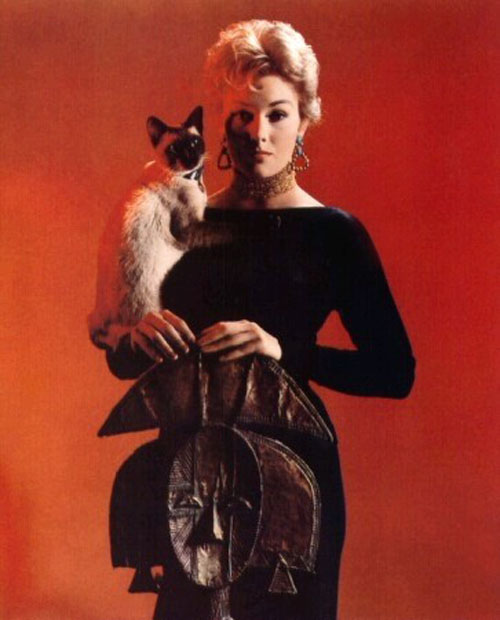
| Judy and I and our friend Jeffrey watched BELL, BOOK AND CANDLE (1958) the other day. Thanks to Jeffrey for bringing with him his DVD of the film. I recall seeing this film one night on a local television station back in the 1960s. It wasn't a network television broadcast, just a local station running the film to fill a two-hour time slot. I enjoyed it then and I enjoyed it the other day. Based on a successful Broadway play, first produced in 1950, the film version stars James Stewart and Kim Novak. Stewart is a New York City book publisher who comes under a spell cast by his downstairs neighbor (and witch) Novak. Novak is part of a coven of witches including Elsa Lanchester and Hermione Gingold while her brother, Jack Lemmon, is a warlock in training. Comedian Ernie Kovacs is a besotted author determined to write a book about real witches in New York but even with the help of Lemmon in the writing of the book, publisher Stewart rejects the manuscript as preposterous. Romantic complications ensue before everything is ironed out in the final reel. BELL, BOOK AND CANDLE is a handsomely mounted production. The leads are all solid (was Novak ever lovelier?) but Stewart struck me as bit old for her. Stewart and Novak had previously worked together that same year on Alfred Hitchcock's masterpiece (and his greatest film) VERTIGO and it's interesting to watch them together in a very different film. BELL, BOOK AND CANDLE received two Academy Award nominations: Best Art Direction and Best Costume Design. It's not a great film by any stretch of the imagination but it was a sheer delight to watch. Recommended. |
Thursday, January 9, 2014
BELL, BOOK AND CANDLE

Monday, January 6, 2014
AVENGERS 1959
 |
| I read AVENGERS 1959 yesterday. This Marvel Comics trade paperback reprints issues #1-5 of the AVENGERS 1959 mini-series. The script and art are both by the great Howard Chaykin, who is one of my all-time favorite comic book creators. I love almost everything about this book. I love Chaykin's art. I love the concept. An Avengers team comprised of characters that were alive and well and operating in the Marvel Universe in 1959 are assembled. The team is made up of Nick Fury, the Blonde Phantom, Kraven the Hunter, Sabretooth, Dominic Fortune and Namora. Added to the mix is Powell McTeague, a British dandy with occult powers who is clearly modeled on the John Steed character played by Patrick Macnee on the classic British TV spy series THE AVENGERS. The Avengers face off against various Nazi supermen and superwomen who survived WWII. The super Nazis are being manipulated by forces within the U.S. intelligence agency (at least, I think that's what's going on). The head manipulator, one Geoffrey Sydenham is apparently an acolyte of the dread Dormammu but that demonic entity is sadly, only name dropped here (pity, as I kept expecting him to eventually show up and I'd love to see Chaykin's take on him). Oh, and did I mention that such familiar Marvel Universe locales as Wakanda, Latveria and Madripoor serve as the settings for some of the action in the book? Plus, there's nifty cameos by former Howler Eric Koenig and 1950s Agent of A.T.L.A.S. Gorilla Man. Yep, there's a lot to like here but there's also much to dislike. For starters, event though I love Chaykin's artwork, there's one two page sequence that makes absolutely no sense to me whatsoever (both visually and narratively) and I even read it twice trying to figure it out. The plot takes practically forever to be adequately explained and even then I'm still not quite sure just what all of this hugger mugger was really all about. The main villain, Sydenham, is not punished for his crimes (although his super Nazi henchmen and henchwomen are) and the book ends on a decidedly ambiguous note. I'm really torn on this one. Thumbs up for the Chaykin art (or at least 99% of it). Thumbs up on the characters and the concept. Thumbs down on a plot and storyline that could have benefited greatly from a really good editor (of which, there seems to be none in today's comic book business). Bottom line: I really wanted to like this one and I did, to some extent, just not as much as I was expecting to. |
Saturday, January 4, 2014
THE LOVED ONE
 |
| British director Tony Richardson won a Best Director Academy Award for TOM JONES (1963), which also was that year's Best Picture of the Year Oscar winner. TOM JONES beat out AMERICA, AMERICA, CLEOPATRA, HOW THE WEST WAS WON and LILIES OF THE FIELD. In my estimation, the film that should have been awarded Best Picture of the Year for 1963 was HUD. I've seen TOM JONES and I think it's one of the worst films to win a Best Picture of the Year Academy Award in the last fifty years. Nevertheless, coming off of the commercial and critical success of TOM JONES, Tony Richardson was riding high and film buffs were anxious to see what he'd do for an encore. What Richardson did was THE LOVED ONE (1965) a jet black comedy (based on the novel by Evelyn Waugh with a screenplay by Terry Southern and Christopher Isherwood) about the American funeral industry (the film also takes aim at Hollywood, organized religion, consumer culture and other targets). The film was advertised as "The Motion Picture With Something To Offend Everyone!" and by 1965 standards, that's a pretty accurate assessment. I watched this cult classic last night for the first time (thanks to a recent showing on TCM) and I'm here to report that I wasn't offended in the least by anything in the film. Your mileage may vary. I also didn't think it was anywhere near as funny as I was led to believe it would be. Oh, I chuckled a few times (it's hard not to laugh at a film in which the great Jonathan Winters plays two parts) but I didn't think it was hilarious. Odd, yes. Bizarre, certainly. Ahead of its' time, definitely. With black and white cinematography by Haskell Wexler and editing by Hal Ashby (both men would later forge their own careers as film directors) THE LOVED ONE has a cinema verite vibe comprised of hand held camera shots and on-location shooting. It certainly doesn't look like the standard mid-'60s Hollywood studio produced comedy and is closer in spirit, visual style and tone to Stanley Kubrick's masterpiece DR. STRANGELOVE. The film finds a young Brit, Dennis Barlow (Robert Morse, who is win, place and show in the Dave Barry lookalike contest) coming to America for the first time. He takes up residence in Los Angeles with his uncle, Sir Francis Hinsley (John Gielgud) who works at a movie studio. When a film project under development gets canned, Sir Francis suddenly finds himself out of work after thirty years at the studio. He takes his own life and it's up to young Dennis to make the funeral arrangements. When Dennis visits the enormous Whispering Glades cemetery and mortuary, he literally goes down the rabbit hole. The facility is run by the Reverend Wilbur Glenworthy (Winters) a con man and real estate tycoon par excellence masquerading as a spiritual leader. Dennis meets a beautiful but simple minded young cosmetician, Aimee (Anjanette Comer), along with the truly outre mortician Mr. Joyboy (Rod Steiger in perhaps the film's funniest performance), and a casket salesman played by Liberace. Dennis is smitten with Aimee and woos her with plagiarized poetry. Aimee is far too stupid to realize that the words he showers her with are not his own. Mr. Joyboy has a twisted fixation on Aimee, which makes for one of the more unusual love triangles in film history. The trouble is, Whispering Glades has reached it's limit as far as available land for burials goes. Rev. Glenworthy devises a scheme to turn his property into a retirement community but in order to do so, he must first disinter the existing graves. How to do so without causing a massive scandal? Enter his brother Henry (also played by Winters), who runs a pet cemetery owned by the reverend. Henry once worked at the movie studio but he was cut lose along with the late Uncle Francis earlier in the film. Dennis works for Henry and the two come up with a sure fire plan, courtesy of Gunther, a young rocket scientist played by Paul Williams. The plan is to launch the coffins into low earth orbit and the first rocket is scheduled to blast off with the remains of a NASA astronaut on board. But someone else is in that coffin when the rocket is launched. THE LOVED ONE was a box-office disaster when it was first released but it went on to be recognized as a cult classic. I've known about the film for years but never had the opportunity to see it until last night. To be honest, I'm not quite sure what to make of it. I didn't hate it. It was imminently watchable and totally unpredictable. As I said, I did get a few laughs out of it but I didn't think it was a comedy masterpiece by any stretch. Bottom line, THE LOVED ONE is certainly worth seeing at least once if you're a hardcore film fan. |
Thursday, January 2, 2014
MY FAMOUS MONSTERS 59
 |
| The titular character from William Castle's film MR. SARDONICUS adorns the cover of FAMOUS MONSTERS #126. Nice painting by Basil Gogos. In addition to MR. SARDONICUS, this issue features articles on KING KONG, Bela Lugosi and Renfield. |
Wednesday, January 1, 2014
MY FAMOUS MONSTERS 58
 |
| The lovely, vampiric Ingrid Pitt is featured on the cover of FAMOUS MONSTERS #122, a cover which is nothing less than a blatant advertisement for the Famous Monsters Convention in New York City. |
Tuesday, December 31, 2013
MY FAMOUS MONSTERS 57
 |
| Someone mucked with the logo again for FAMOUS MONSTERS #119. This abomination may even be worse than the one that appeared on the cover of issue #100. I don't know why someone (Jim Warren? Forry?) felt the need to change one of the most distinctive magazine logos ever but they did so at least twice during the magazine's first run. The cover images on this issue are from a variety of Hammer horror films and the fact that it's billed as a "100 Page Super Spooktacular Issue" clues me in that's it's an all reprint annual issue (what Forry used to lovingly refer to as a "Fearbook" rather than a "Yearbook"). Features include the usual suspects: Boris Karloff, Bela Lugosi, Christopher Lee, Dinosaurs and NIGHT OF THE BLOOD BEAST (!?). |
Saturday, December 28, 2013
WASTELAND
 |
| Full disclosure time. WASTELAND BOOK ONE: CITIES IN DUST is a book I would have never purchased for myself. If I saw a copy of this trade paperback sitting on the shelf of a bookstore or comic book shop, I would never even pick it up and thumb through it. Why? I dunno, other than it just doesn't grab me at first glance. But since I recently acquired copies of the first two trade paperback collections of this series in a comic book trade with a fellow collector, I figured the least I could do was give it a chance and read it before I put it up for sale on eBay. And that's just what I did today. The Oni Press series is written by Antony Johnston and illustrated by Christopher Mitten , two gentlemen who's work I am not familiar with. The first book, CITIES IN DUST, collects the first six issues of this ongoing series, which has seen more than fifty monthly issues published thus far as well as eight trade paperback collections. WASTELAND is a post-apocalyptic epic adventure set one hundred years after a disaster known only as "The Big Wet" has occurred in the United States. The country has been reduced to a barren wasteland (hence, the title) and what few survivors there are lead a hardscrabble existence. A stranger comes into the small town of Providence one day and before long all hell has broken loose. The handful of citizens that survive are led by the stranger to Newbegin, the nearest outpost of civilization. But the desert city is under the rule of a mad priest who fancies himself a god. There are clues and hints dropped along the way as to the secret behind the disaster and what's really going on but Johnston and Mitten play their cards close to the vest. I'm sure parts of the puzzle have since been revealed but after reading only this first volume, I'm still pretty much in the dark. WASTELAND plays like a million other westerns/post-apocalyptic yarns. It's neither better than average or worse. It hits all of the narrative tropes and has enough action and intrigue to keep readers interested and turning the pages. The black and white art by Mitten is serviceable although at times his figures look too loose and sketchy and many of his male characters are hard to tell apart due to their hair, face and body similarities. I'll give the second volume a read since I have a copy but I don't think I'll be actively seeking out any additional volumes in this series. It's not bad, it's just not that great either. |
Subscribe to:
Posts (Atom)